

Breaking New Ground in Ultrasound Technology: Hisense Medical Unveils Cutting-Edge Innovations at China’s Top Ultrasound Conference
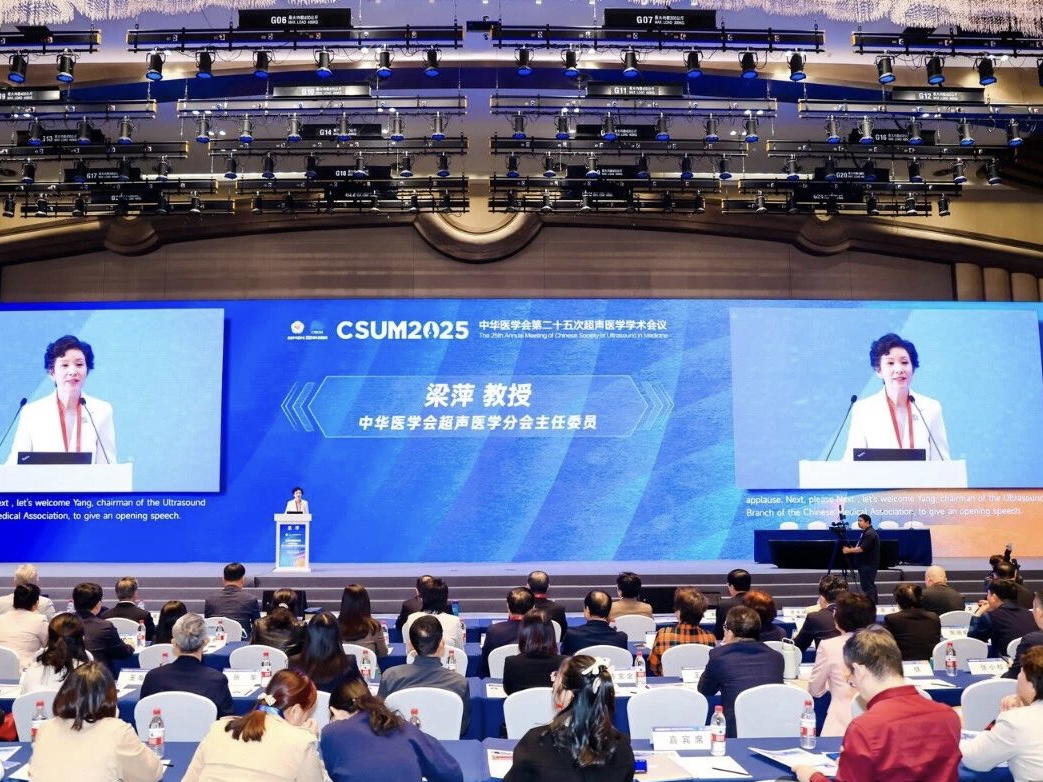
On November 13, the 25th Annual Meeting of the Chinese Society of Ultrasound in Medicine was held in Hangzhou, bringing together ultrasound experts and scholars from across the nation to explore the latest industry trends. At this premier event, Hisense Medical unveiled two revolutionary innovations: a real-time navigation technology powered by multimodal 3D image fusion, and the new-generation Aisense series of portable ultrasound systems. These technological breakthroughs respond to the demands of precision medicine, injecting new impetus into precise diagnosis and treatment in interventional ultrasound, while strengthening medical service capacity at the grassroots level.
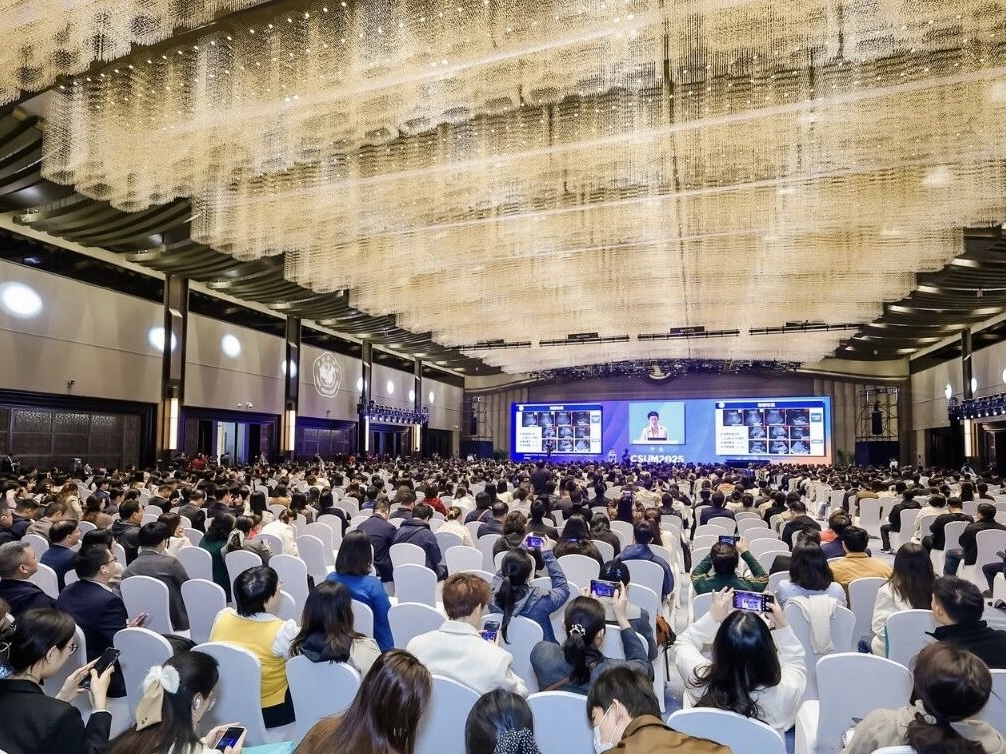
As ultrasound technology advances, single-modality imaging can no longer meet the core clinical demands for high-precision localization, real-time guidance, and 3D visualization. As a key trend addressing industry bottlenecks, multimodal image fusion is proving its value in improving the accuracy and safety of diagnosis and treatment, especially in core scenarios such as minimally invasive interventions. It is reshaping clinical workflows and emerging as a major topic of discussion among experts at the conference. The deep integration of multimodal fusion and intelligent empowerment is widely recognized as a critical path to expanding diagnostic boundaries and elevating treatment quality.
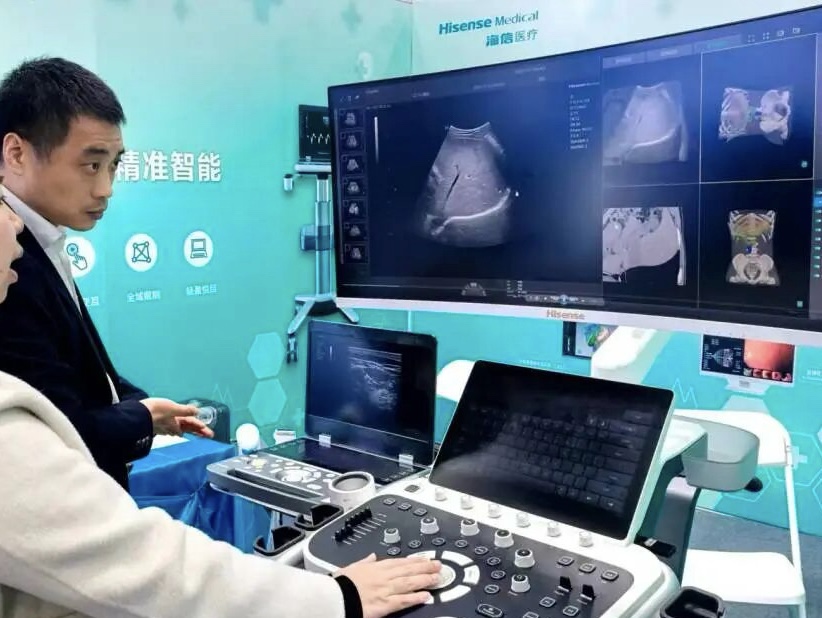
Hisense Medical’s newly launched real-time navigation technology, built on multimodal 3D image fusion, integrates three core capabilities: 3D imaging, surgical positioning and navigation, and ultrasound image fusion. It delivers an innovative all-in-one solution featuring "precise preoperative planning + real-time intraoperative guidance." Before surgery, it synthesizes multimodal data to accurately delineate lesions and surrounding anatomical structures, enabling scientific needle path planning and reducing surgical risks from the start.
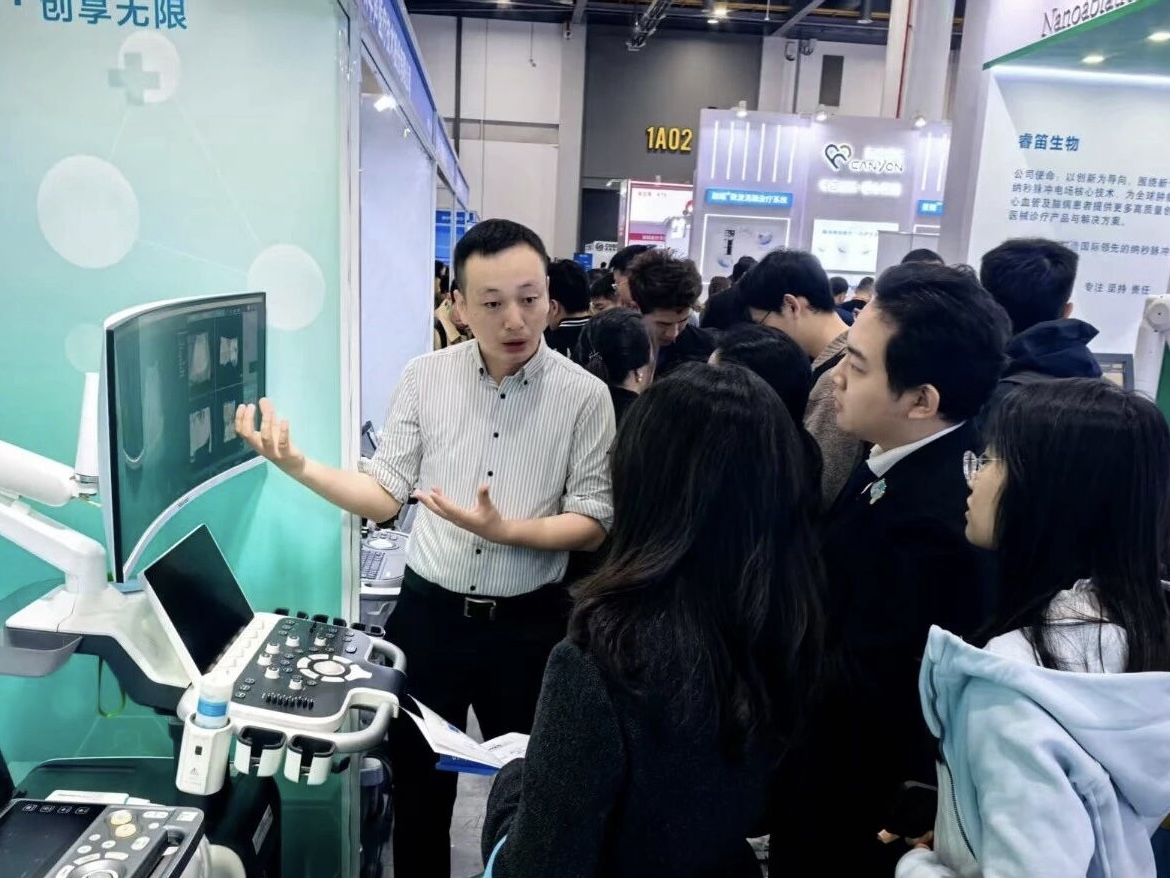
During surgery, cutting-edge positioning and navigation technology achieves millisecond-precise registration between real-time ultrasound images and CT/MRI 3D models, overcoming the limitations of blurred spatial information and insufficient quantification in traditional ultrasound. Supported by efficient 3D segmentation modeling and quantitative analysis, the technology enables accurate efficacy evaluation, fully satisfying the core clinical requirements of "precision, visualization, quantification, and controllability." It has delivered outstanding clinical performance in tumor ablation, puncture biopsy, and other applications. Its high-precision spatial fusion capability significantly improves surgical safety and therapeutic outcomes, earning high recognition from on-site experts and becoming a spotlight technology at the exhibition.
With the in-depth advancement of the tiered diagnosis and treatment system, portable ultrasound has become a standard tool for emergency bedside care, community home visits, grassroots medical outreach, and other scenarios. Clinical demands have evolved from "portable and usable" to "precise, efficient, and clinician-centric." Traditional portable ultrasound systems often fall short in imaging quality, ergonomic design, and physician occupational health protection, failing to meet the upgraded needs for precision diagnosis and long-duration operation across diverse scenarios.
Hisense’s Aisense series portable ultrasound systems precisely target these industry pain points, redefining the user experience through a user-centric design. Featuring an aviation-grade lightweight build, the systems are ultra-portable and easy to operate—so much so that even a single female healthcare worker can lift them with ease. Suitable for emergency bedside assessments, cross-departmental hospital consultations, community follow-ups, and grassroots screening, the devices enable rapid examinations anytime, anywhere, without complicated setup. Backed by Hisense’s decades of display technology expertise, the systems incorporate three hardware-level eye-protection functions: low blue light, flicker-free DC dimming, and intelligent brightness adjustment, specifically designed to relieve eye fatigue caused by long hours of image reading.
The products also excel in core performance and intelligent applications. Equipped with the self-developed Hpower platform and pixel-level beamforming technology, they deliver high-quality image output across all clinical scenarios, dispelling the industry misconception that "portable means compromised imaging." Integrated with artificial intelligence, the systems provide standardized operational guidance and automated auxiliary analysis, acting as a reliable "intelligent assistant" for grassroots clinicians. This empowers doctors at all levels to deliver efficient and accurate diagnoses, perfectly adapting to the demands of all-scenario mobile diagnostics.
Today, ultrasound technology is rapidly moving toward the deep integration of precision, intelligence, and universal access. Medical devices are evolving from simple diagnostic tools into all-scenario "intelligent assistants." Upholding its mission—"Committed to technological innovation, empowering medical diagnosis with premium products and services to improve the wellbeing of millions of families"—Hisense Medical proactively adapts to industry shifts with forward-looking strategies and closely aligns with clinical needs to address full-scenario medical demands.
Going forward, Hisense will continue to lead industry development through technological innovation, making high-quality medical services borderless and accessible, and contributing Chinese strength to the high-quality development of global healthcare.